Machines
The phone in your pocket outruns the first teraflop supercomputer
In 1997 the world's fastest computer drew 850 kilowatts and filled a room to reach one teraflop. Your phone's graphics chip does nearly five, on a battery.
The fastest computer on the planet in 1997 filled a room at a national weapons lab, pulled 850 kilowatts, and needed its own cooling plant. The one in your pocket is quicker.
ASCI Red was the first machine to cross a teraflop, a trillion floating-point operations a second. Intel built it for Sandia National Laboratories, it broke the barrier in a December 1996 run before the full machine was even assembled, and on the June 1997 TOP500 list it sat at number one with 1.068 measured teraflops, almost three times the machine below it.
The record run used 7,264 Pentium Pro processors, the same 200 megahertz chip that shipped in desktop PCs, wired into one enormous mesh. By TOP500's accounting the full machine spread 104 cabinets across about 230 square meters, held 1,212 gigabytes of distributed memory, and stayed on top of the list for seven straight editions. A 1999 upgrade to 9,632 Pentium II OverDrive chips pushed it past three peak teraflops. The sticker price is the one number I went looking for and could not pin down.
Your phone clears all of it. The spec tables disagree on the exact figure for the Adreno GPU inside a 2024 Snapdragon 8 Gen 3, from roughly 4.7 teraflops at the cautious end to 6.1 at the listed peak. Take the low number and the phone chip is still more than four ASCI Reds, running on a battery, in a jacket pocket.
So the supercomputer a country built to simulate nuclear weapons is now a rounding error against the thing you use to answer texts. That is the receipt, and it should feel stranger than it does.
The line has not stopped moving
While I had the TOP500 archive open, I checked the other end of the curve. On the June 2026 list the number one machine is LineShine in Shenzhen at 2.198 measured exaflops, with El Capitan second at 1.809 and Frontier third at 1.353. An exaflop is a million teraflops. The 1997 champion would land around two-millionth place against the current leader, if the list went that deep.
The power column tells the quieter story. ASCI Red spent 850 kilowatts buying its single teraflop. LineShine draws 42,220 kilowatts for its 2,198,400, which works out to roughly 19 watts per teraflop, better than forty-thousand times thriftier per unit of math. Your phone rides that same efficiency curve, which is the only reason the thing in your pocket is not also a cooling plant.
For calibration, LineShine is only the fifth machine in history to measure an exaflop, and it just ended El Capitan's run on top. ASCI Red's seven straight editions at number one look positively leisurely from here. The summit got taller and the visits got shorter.
Twenty-nine years separate those two machines. The pocket version of this story repeats on a loop: today's number one becomes tomorrow's phone chip, and nobody holds a ceremony.
Where the teraflops hide
A phone's real muscle is the GPU. That Adreno packs 1,536 single-precision units running the same arithmetic across thousands of numbers at once, which is the exact shape of a graphics frame and, as it turns out, of most machine learning. ASCI Red bought its teraflop with thousands of general-purpose CPUs and a building. The phone gets several from one sliver of silicon by refusing to be general.
One honesty footnote before anyone frames this. ASCI Red's 1.068 was a measured Linpack run, hours of sustained arithmetic under supervision, while a phone GPU's spec-sheet teraflops are a peak figure the chip holds until it warms the glass. A phone throttling under sustained load will give back some of that margin. It does not matter to the verdict: cut the 4.7 in half and the pocket still beats the building more than twice over.
The purpose gap is its own piece of vertigo. ASCI Red existed because the United States stopped live nuclear testing in 1992 and chose to simulate the stockpile instead, which is why the first teraflop lived at a weapons lab and not a university. The machine that out-muscles it today exists to make a photo app scroll at 120 frames a second. Swords into very small ploughshares.
Line the parts counts up and the trade is visible. ASCI Red: 7,264 processors, each a complete computer with its own fetch and branch machinery, spread over 104 cabinets. Adreno: 1,536 arithmetic units sharing one instruction stream on one die. A fifth the count, a building less plumbing, several times the math, because the units skip everything that is not arithmetic.
The old catch was reach. Only a native app could touch that hardware, and a web page got a slow, polite fraction of it. That wall came down in May 2023, when Chrome shipped WebGPU in version 113. A browser tab can now hand raw compute jobs straight to those GPU cores, compute shaders writing into storage buffers, no game engine in the way. Google's launch post claimed better than threefold speedups on machine-learning inference over the WebGL workarounds it replaces.
Pair that with WebAssembly, which already boots a whole Debian Linux in a tab and emulates four decades of Macintosh, and the browser stops being a document viewer that also does sums. It becomes a way to aim the entire chip at a problem. The fluid simulation that solves Navier-Stokes in a fragment shader managed its magic through WebGL's narrow keyhole; WebGPU takes the door off its hinges.
What people aim the chip at
Three years in, the WebGPU scene has receipts of its own. The ones I keep coming back to:
- WebLLM, 19,217 stars, runs full chat models inside the tab with no server behind the conversation, pushing tokens through those same GPU cores your games use.
- compute.toys is the playground layer, a shader-sharing site for raw WGSL compute, currently pages deep in community experiments, from fluid solvers to neural networks scribbled as shader code.
- The machine-learning speedup Google claimed at launch, better than three times over the WebGL workarounds, is why in-browser inference went from demo to default in two years.
None of that touches a native app store. The compute was in your pocket the whole time; the web just found the handle.
The gap is the part that gets me. You are carrying more parallel compute than the 1997 nuclear weapons program, behind a sheet of glass, and most of it spends the day holding a text field steady while you type.
If you want to point yours at something, WebGPU Fundamentals starts at a blank page and works its way up to compute shaders. Open a demo and listen to the fans that are not there stay quiet.
Next up
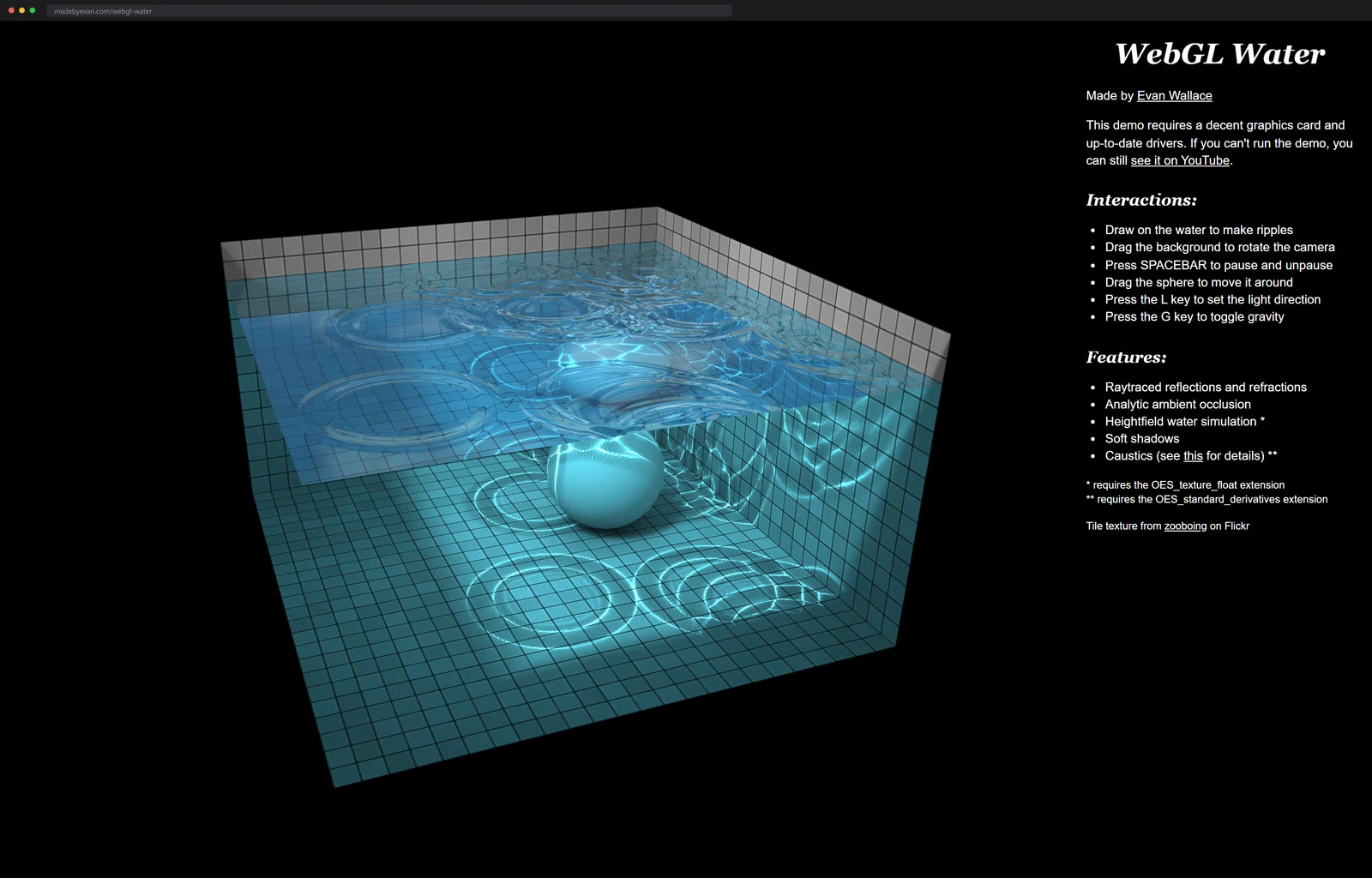
The raytraced pool from 2011 that its maker built before Figma