Play
A parody operating system that boots to a desktop full of working toys
Windows 93 is a fake OS in the browser that plays the PlayStation boot chime and hides dozens of real little apps and games behind its pixel-art icons.
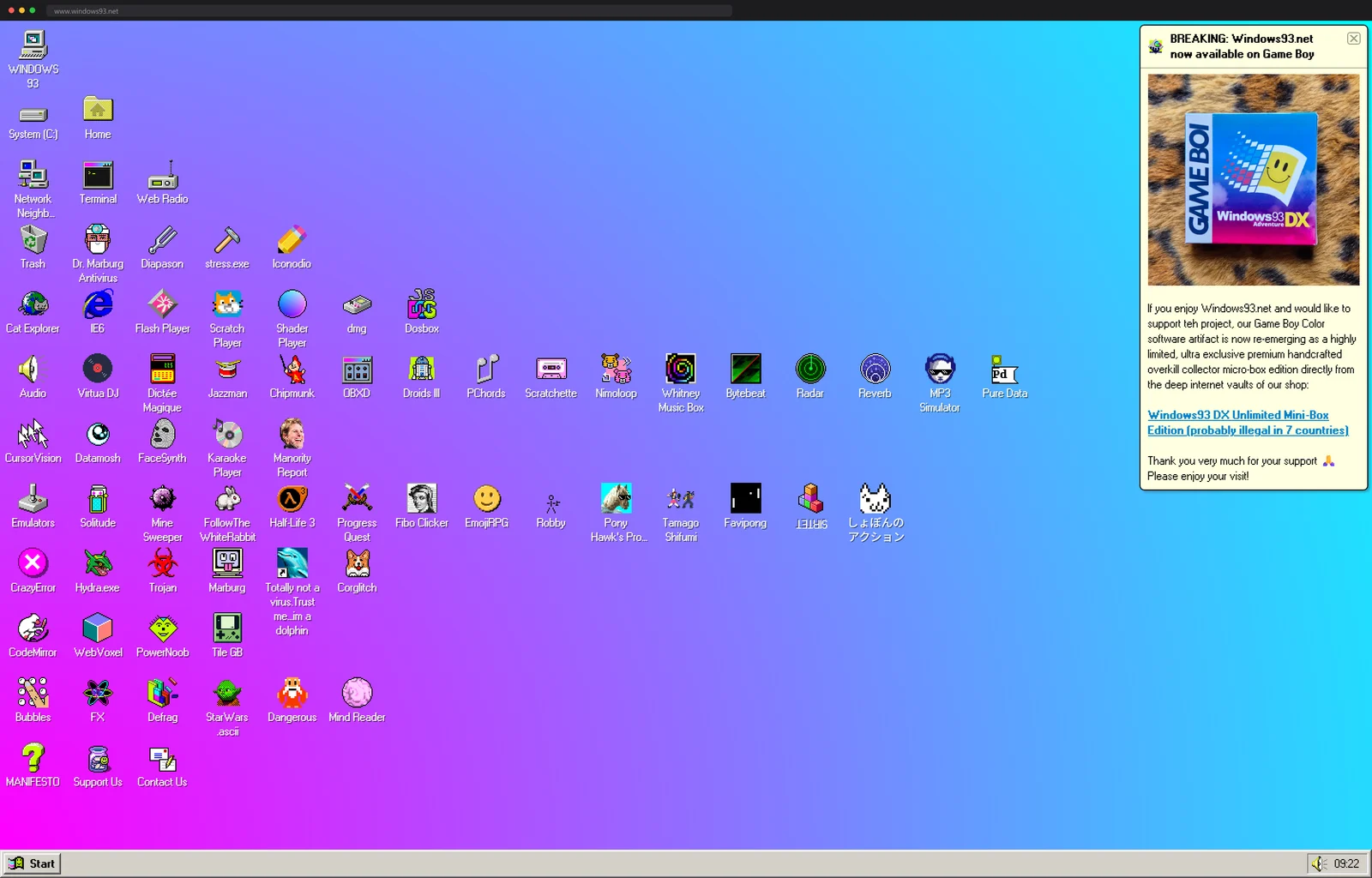
It boots with the PlayStation start-up chime, which is the first joke, and resolves into a purple desktop crowded with pixel-art icons: Cat Explorer, a Solitaire parody, a Wolfenstein clone, a working pixel-art editor, a chat room, something ominously named CrazyError. There is a Start button. There is a taskbar clock.
Windows 93, by the French duo jankenpopp and Zombectro, is a fake operating system that runs entirely in your browser, and the reason it earns a sighting rather than a meme's lifespan is how much of it actually works. The first public build went up in October 2014 and pulled around four million users inside two weeks. Version 1 proper landed on the first of November 2014, version 2 followed in June 2017, and version 3, a rewrite of the whole thing, opened as a public beta on Valentine's Day 2023.
Four million people in two weeks, for a parody. The internet knows what it wants.
A window manager wearing a costume
What is running underneath is a JavaScript window manager, plain HTML, CSS and JavaScript pretending to be system software. Every icon opens a real, self-contained web app inside a draggable window with a title bar and a close box, and the desktop metaphor holds: windows stack and minimize to the taskbar, and the clock keeps actual time.
Some of the apps are jokes that do one absurd thing. The rest are genuine tools wearing a costume. The pixel editor is Piskel, an actual open-source sprite editor with its own site and desktop builds. The Amiga in the fake machine is SAE, a real JavaScript Amiga emulator, so there is a whole second computer running inside the parody of a first. Trollbox is a live chat with actual strangers typing in it. Deeper rows hold a Virtual PC, a Maze 3D and an ASCII gallery, and both makers are musicians as much as programmers, which is why a MIDI jukebox sits within reach of the desktop.
The 2023 rewrite restocked the shelves without breaking character: a Wolfenstein parody called GAFA 3D, a fighting game called KOF '93, Chess960, a text editor, a media player. The reference layer stays period-correct throughout, icons and apps mining the memes of the late nineties and early two-thousands, so the desktop reads like a core sample of an internet that no longer exists.
The craft hides under the gag. Making one fake OS chrome is easy. Making dozens of little apps that all live inside it, boot, and behave, then keeping them alive across nine years of versions, is the part that took real work.
The week the press logged on
The launch coverage is its own little time capsule. Gizmodo wrote up the full release on the sixth of March 2015, five months after the four-million-user fortnight, pitched it as the more primitive, meme-filled edition of Windows 95, and spent most of the piece just listing what it found: Solitude where Solitaire should be, Cat Explorer in the Internet Explorer slot, Castle GAFA 3D, and a program called Virtual Girl the reviewer declined to describe. There is an ASCII-rendered Star Wars playing in there too, the ancient telnet gag reborn as a desktop accessory. The verdict was that the desktop was packed to the gills with insider internet jokes, which is the correct reading and also undersells how much of it runs.
Eleven years later that article doubles as an archaeology layer. Half the apps it names are still on the desktop, some renamed, some rebuilt, and comparing its list against the current build is the closest thing Windows 93 has to a public changelog.
What I went looking for and could not find is a long-form interview where the two of them walk through the code. There is no conference talk, no engineering blog, no architecture diagram anywhere I could turn up. The closest thing to a maker's statement is the desktop itself: both are working musicians, the credits live inside the fake OS, and the MIDI jukebox says more about them than a changelog would.
The fake desktop became a genre
Windows 93 was loud enough that the form now has serious entries, each answering a different question. The parody asked how weird a desktop could get. Its successors asked how real one could get, and I chased down the two best answers.
Windows96.net arrived in 2019 and imagines the release that never happened between 95 and 98, except it commits harder to being a real system than the parody premise requires. It has earned its own Wikipedia page, which for a fake OS is its own kind of arrival, and the feature list justifies it: a package manager that one-click installs the Doom shareware and a Half-Life demo, and a live chat of whoever else is sitting at the fake desktop with you. The stack under it is HTML5, CSS, JavaScript and WebAssembly, and PC Gamer's two-word review, surprisingly fleshed out, is the right amount of surprised. Some of its apps are still stubs, which in this genre reads less like a bug and more like a roadmap.
98.js.org plays it completely straight instead, a faithful Windows 98 in the browser by Isaiah Odhner, whose jspaint sits on 7,900 GitHub stars for remaking MS Paint pixel for pixel, then quietly beating it: the original gave you three levels of undo, jspaint keeps a whole branching history tree you can walk back through. Then it keeps going past the joke entirely. The readme lists speech recognition, head-tracker input for hands-free drawing, multi-user sessions, and a tool that renders your undo history out as an animated GIF, which means the remade Paint is more accessible than most real software I use.
And if clicking around these gives you the itch, the window chrome is now a solved problem. Odhner publishes the parts as os-gui, a 257-star JavaScript and CSS library of draggable Windows 98 windows, menu bars and buttons that can even load real Windows .theme files for its colors at runtime. The scrollbar arrows are drawn procedurally, the menus carry real keyboard navigation and ARIA attributes, and the whole kit is what 98.js itself runs on. The desktop is the easy part now. The thirty working toys inside it are still on you.
The tour is just clicking
There is no map, and there should not be one. Open CrazyError and accept the consequences. Let the chat scroll by. Draw something in Piskel and save it like the machine is real, because at that point it functionally is.
More old computers reborn in the tab, this time for real: dozens of operating systems you can actually boot, or every classic Mac since 1984 in one place.
Next up
A whole animation in 140 characters of JavaScript