Play
The Game of Life went continuous and started growing creatures
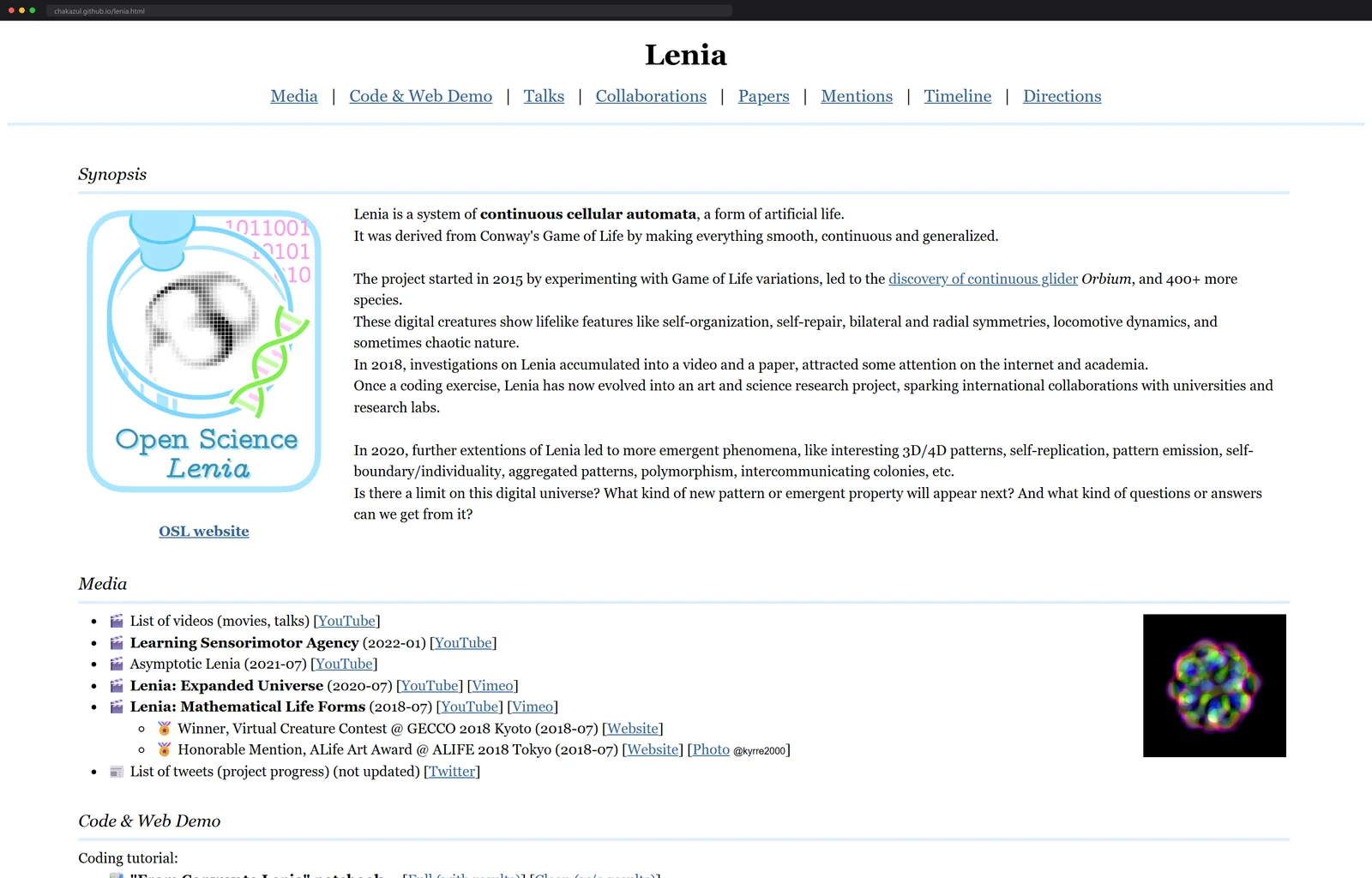
Lenia takes Conway's Game of Life off its grid of on-off cells and makes it smooth. What emerges are gliding, self-repairing creatures. More than 400 have been catalogued.
Conway's Game of Life is cells on a grid, each one alive or dead, ticking in hard steps. Take that same idea and make everything smooth, the space, the time, the states, and the blocky gliders turn into something that looks disturbingly like it is swimming.
Lenia, by Bert Wang-Chak Chan, is that smoothed-out Game of Life, and the things it grows behave like animals. They hold a shape, they move under their own power, they repair themselves when you damage them, and some are radially symmetric like jellyfish. Chan started the experiments in 2015 as a coding exercise, and the first creature to swim out of them, a glider now catalogued as Orbium, opened a zoo that has passed four hundred species across eighteen families, each one filed under a Latin binomial name like a proper specimen.
I watched an Orbium cross the field for longer than I will admit. It does not hop square by square the way a Conway glider does; it swims, holding its internal pattern steady while the whole body drifts, and the catalog around it ranges from those swimmers through spinning polygons to radial things that could pass for a plankton survey.
The whole engine is a blur and a bump
Here is the rule that brings them to life, and it is a small one. The grid holds smooth values instead of on and off. Each step, you blur the field with a fixed ring-shaped kernel to measure each cell's neighborhood, then push the result through a gentle growth function, a bump that says "this much neighbor means grow, that much means shrink," and nudge the field by a tiny amount. That is the whole engine. Because nothing is forced to a hard zero or one, patterns can hold together and glide instead of flickering.
The name is a receipt for exactly that: Lenia comes from lenis, Latin for smooth.
Once you see the rule this way, the zoo makes sense. A "species" here is nothing but a point in parameter space, a particular kernel radius, growth center and growth width where some blob happens to hold together, and the eighteen families mark out the neighborhoods of that space where stability keeps turning up. Swap the single kernel ring for two or three concentric ones and whole new families appear. Discovery in Lenia is not writing code; it is prospecting through parameters.
Computationally, each step is one big convolution across the whole field, a texture rewritten in place over and over, the same shape of work as the GPU fluid solver sighted here before.
That is why the reference implementations span a speed ladder: the original JavaScript version, slowest and friendliest, a Matlab port built for statistics, and a Python version that runs on the GPU and carries the multi-kernel, multi-channel extensions where the strangest creatures live. The same rule pushed into three and four dimensions grows creatures there too, and the repo holds those builds as well. For a research codebase with a zoo attached, 3,900 stars and 253 forks is a crowd.
The receipts stack up. The paper documenting it, published in the journal Complex Systems in 2019, took the International Society for Artificial Life's award for the year's outstanding publication, after the creatures had already won the virtual-creature contest at GECCO 2018 in Kyoto. Chan has since told the whole story as a Stanford seminar, Lenia: Biology of Artificial Life, the discovery narrated by the discoverer, and it is the recording I would hand anyone who wants the project in his own words.
The unsettling bit is watching two of them collide and fuse, or one shed a piece that grows into another. Nobody wrote those behaviors. They fall out of the arithmetic, which is the entire point.
The family tree keeps branching
Lenia has an ancestor, and by now it has descendants.
The ancestor is SmoothLife, Stephan Rafler's 2011 generalization of Conway's rules to a continuous domain, which proved the smoothing move could work years before Lenia's creatures made it famous.
The descendants go after the original's one piece of unphysical behavior: classic Lenia can conjure matter out of nowhere, so two creatures never really compete for anything. Flow Lenia, a 2022 paper by Erwan Plantec and colleagues with Chan among the co-authors, makes the update rule mass-conservative, matter moves instead of appearing, and then embeds the rule parameters into the simulation itself, so patches of world running different rules can meet, blend and evolve. If the phrase "open-ended evolution" raises your pulse, that is the paper.
Particle Lenia, from Alexander Mordvintsev, Eyvind Niklasson and Ettore Randazzo at Google, swaps the field for particles entirely: a rotor that organizes itself out of 200 particles, the same pattern upscaled to 800, and a 3D mushroom-shaped glider holding formation with 256. In the proper Lenia tradition, the page runs its demos live rather than showing you a screenshot.
Go grow one
The original simulator runs in the browser with every knob exposed: kernel radius, growth center, time step, and a shelf of preset creatures to load. Drop an Orbium in, carve a piece off it, and watch it close the wound.
Those knobs are the same symbols from the paper, which makes the simulator a lab bench rather than a toy: nudge the growth center a hair and watch a healthy swimmer dissolve, nudge it back and watch the species boundary you just crossed. Twenty minutes of that teaches more about dynamical systems than a semester of slides.
More complex behavior falling out of a simple rule: a paperclip factory that turns into a lecture on runaway goals.
Next up
Fold a Julia fractal until the math finally makes sense