On the web
The blog where every diagram is a React toy you can grab
Josh Comeau writes CSS tutorials where the diagrams are live React components built in MDX. Drag a flex item and the illustration rearranges under your finger.
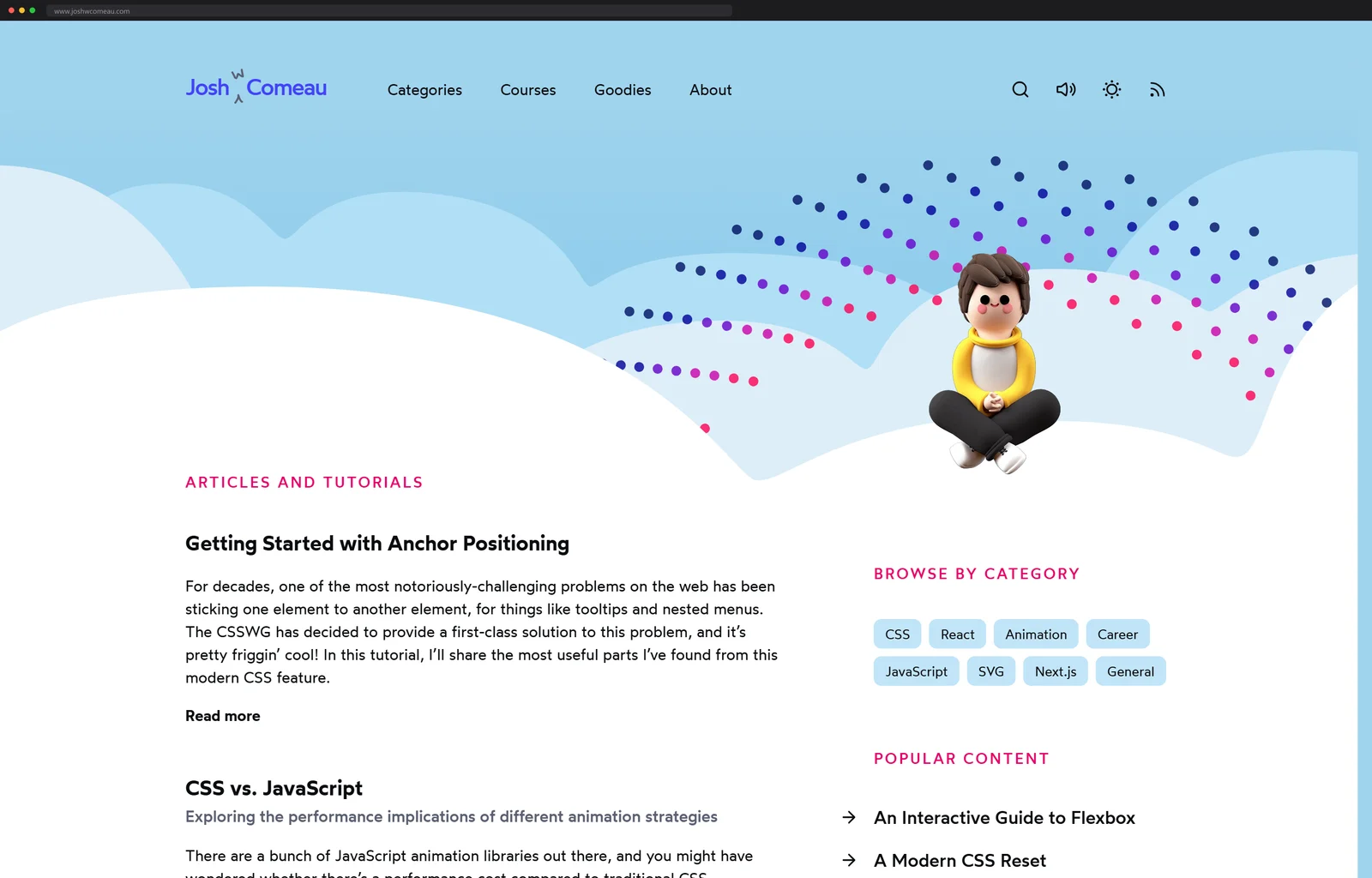
Hover the little 3D avatar on the homepage and it springs, a quick squash and settle, before going back to sitting cross-legged in its yellow hoodie. Josh Comeau named that animation "boop" after a poll, and it is the smallest hint of what the whole site does differently.
joshwcomeau.com is a blog about CSS and React where the explanations are not screenshots of code, they are the code, running. His interactive guide to Flexbox lets you drag the controls and watch the boxes rearrange in real time, because the diagram is a live component and you are steering it.
The stack under the whimsy
The thing that makes this possible is MDX, a version of Markdown that can import React components, so a paragraph of prose sits directly beside a working widget and the widget is the illustration. Comeau lays out the machinery himself in How I Built My Blog, v2, his September 2024 rewrite: Next.js on the App Router, MDX v3 handled through next-mdx-remote, styling in Linaria so it compiles down to zero-runtime CSS Modules, code blocks highlighted by Shiki, live React playgrounds via Sandpack, MongoDB behind the dynamic bits.
The scale is the receipt. The blog is over 100,000 lines of code before counting a word of content, TypeScript throughout, with Algolia driving the search box, and the rewrite meant migrating roughly 1,500 styled-components to the new styling setup. He has been building the site in public since the first version in 2017, and the writeup is refreshingly plain about what fought back, MDX migrations most of all.
The writeup is also where the uncomfortable numbers live, because he publishes those too. The CSS bundle on a typical post weighs 245 kilobytes uncompressed, of which about 47 kilobytes actually get used, a tradeoff he walks through rather than hides. He shipped the rewrite on Next.js 15 and React 19 while both were still in beta. Even the heart button in the corner is engineered: each reader can click it up to sixteen times per post, with readers told apart by hashed IP addresses sitting in that MongoDB instance.
Those live playgrounds deserve a second look, because they are the most radical part. Sandpack, the library behind them, is CodeSandbox's in-browser bundler wrapped as a React component, which means the editable code samples in his courses and posts compile and run entirely in your tab. Change a line and the preview re-renders. The code block is not a picture of a program. It is the program, handed to you still running, and that is the Flexbox guide's trick generalized to everything.
The boop itself gets a full tutorial article, and it holds the sentence that explains why the site feels the way it does: "Instead of using the Bézier curves that CSS provides, it'll use spring math instead." The motion runs on react-spring, a physics model with tension and friction knobs rather than fixed CSS timing, which is why the avatar feels like a real object settling instead of a linear fade.
react-spring's own docs make the case in one line, arguing that animation set by duration and curve is opposed to fluid interactivity because nothing in the real world moves that way. The web build of the library costs 19.2 kilobytes, which is a small bill for a site where every nudge and settle runs on physics. Comeau actually carries two animation libraries, with Framer Motion's 44.6 kilobytes alongside for the layout-level moves, and the v2 writeup itemizes both costs rather than rounding them away. The whimsy is budgeted. That might be the most grown-up sentence I have ever written about a bouncing cartoon avatar.
Why widgets beat diagrams
A static diagram shows you the answer. A widget you can break shows you the rule, because you get to find the edge where it stops behaving. That is a far harder thing to build, six figures of code harder, and a much better thing to learn from.
Three more blogs built like instruments
Comeau is the loudest voice in a small guild of people who treat a blog post as something you tune rather than type. The three I keep going back to:
- Build your own React, by Rodrigo Pombo, rebuilds React from scratch as a toy library called Didact across eight steps, with the code highlighting itself in sync as you scroll the prose. Published in November 2019, and he had to build a new blog and new tooling just to present it this way.
- That tooling grew up into Code Hike, an open-source bridge between Markdown and React for exactly this kind of walkthrough, now backed by the GitHub Accelerator. If MDX is the trailhead, Code Hike is the fitted boot.
- Amelia Wattenberger's site applies the same move to data visualization: essays on D3 and SVG where the charts respond to you, from a researcher now prototyping new interfaces at GitHub Next.
A sibling with no React at all: a circuit simulator essay that re-solves itself while you watch gets the same effect from hand-rolled canvas code.
If you want the trick in your own writing, MDX's getting-started docs are the trailhead, with integrations for most bundlers and frameworks, and Comeau's v2 writeup doubles as the advanced course. CSS pushed past its job description is a running theme in these sightings: an entire illustration drawn with one div is what that looks like with no JavaScript at all.
More explanation you steer instead of read: a mechanical watch taken apart gear by gear.

Next up
This house has a brain, and it forgets on purpose