Machines
Watch current move through a circuit that re-solves itself constantly
Falstad's Circuit Simulator animates real electronics in the browser, yellow dots for current, live scope traces, re-solving the whole circuit every few microseconds.
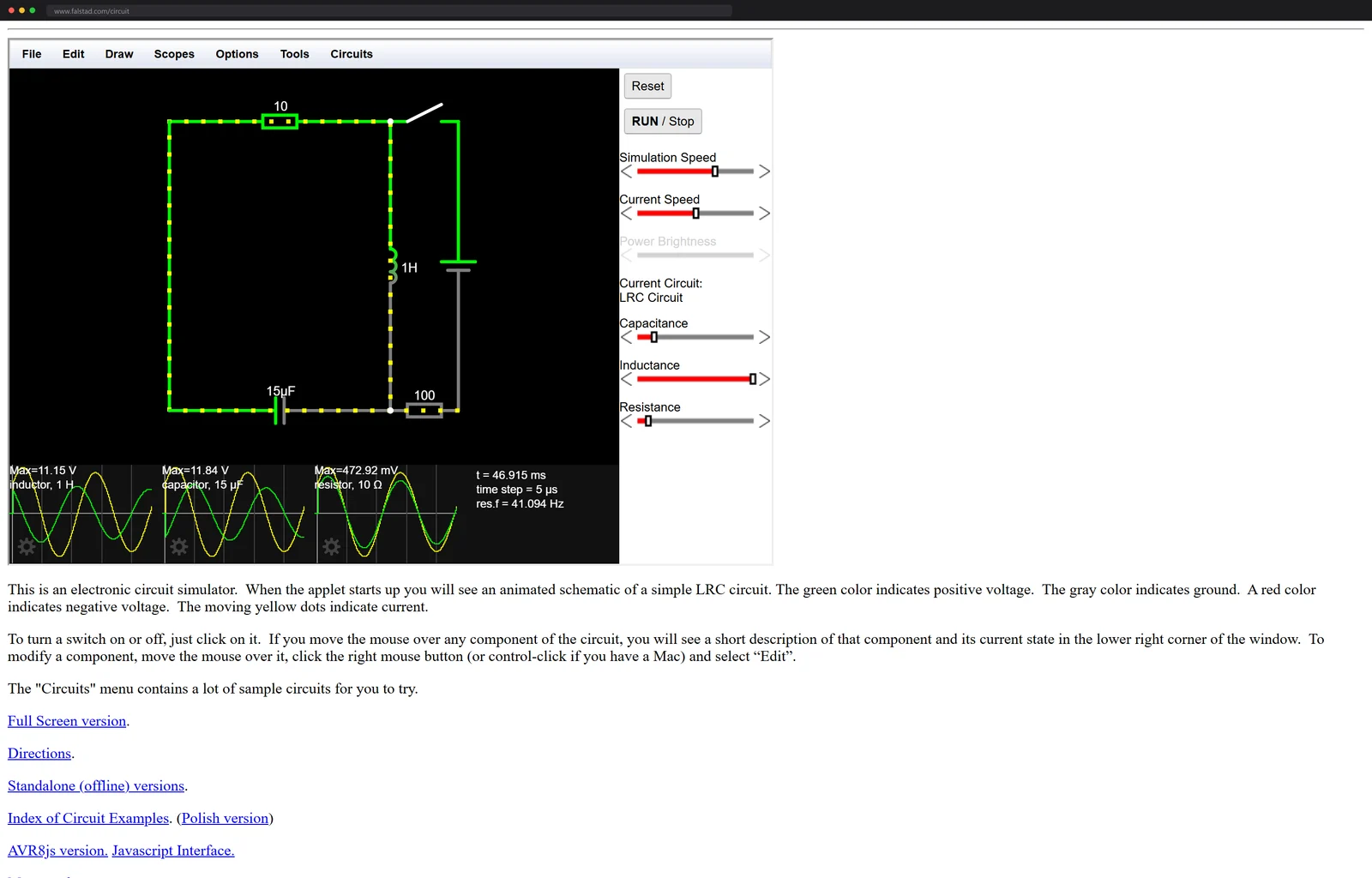
The page opens on a circuit that is already running. Yellow dots crawl along the wires, the wires glow green where the voltage is positive, and three little oscilloscopes at the bottom trace the voltage and current rising and falling in real time.
This is the Falstad Circuit Simulator, and it is the tool an entire generation learned electronics from. Paul Falstad wrote the original as a Java applet back in the plugin era; the earliest Wayback Machine capture of falstad.com dates to February 2001, and an exact launch year for the circuit applet is the one number I went looking for and could not find. The default circuit is a live LRC loop with the current visibly sloshing between the inductor and the capacitor.
Java in, JavaScript out
The port is my favorite part of the build. Rather than rewrite the applet when browsers killed Java, Iain Sharp ran its source through GWT, Google's Java-to-JavaScript compiler, so the simulator in your tab is still Falstad's original Java, machine-translated and plugin-free. Falstad maintains that repo himself, GPL-licensed, at 2,300 GitHub stars.
The repo's credits read like a small guild forming around one teacher's tool: Edward Calver contributed fifteen new components, Rodrigo Hausen built the file import and export, J. Mike Rollins wrote the Zener diode code, and a row of volunteers translated the interface into their own languages. A simulator old enough to predate its own platform, still gaining parts.
Here is what those dots cost to compute. Electronics is not something
you can animate by eye, so every timestep the simulator writes the
whole circuit out as a matrix of how each node connects to the others
and solves it by nodal analysis, the same linear algebra a real SPICE
tool uses. The source is charmingly literal about it: components
install themselves through methods named stampResistor,
stampConductance and stampVoltageSource, and the finished matrix
goes through a sparse LU solver.
Anything nonlinear, a diode or a transistor, will not sit still inside a linear matrix. So it gets linearized around a guess, solved, re-linearized and solved again until the numbers stop moving, and the engine will grind through thousands of those sub-iterations before it gives up and stops with a convergence error. When a step will not settle it halves the timestep and retries; after three clean solves it eases back up. The default circuit steps five microseconds at a time, the value 0.000005 written right in its circuit file, and the dots you see are those solutions, redrawn thousands of times a second.
The gift of it is that you can grab any component and change it while it runs. Drag the resistance down and watch the oscillation take longer to die. Nothing recompiles or restarts. The matrix is simply restamped around your change, mid-flight.
The library goes deeper than the menu suggests: 373 example circuit files ship with the source, from a single diode through op-amp designs up to full digital logic. If wiring gates sounds better than dragging resistors, there is a puzzle game that walks you from one NAND gate to a working CPU.
When you want to build rather than browse, the directions pages cover the editor, the scopes, and importing and exporting circuits as text, the same format those 373 examples use.
The shelf this one came off
The circuit simulator turns out to be one jar in a very long pantry. Falstad's applet index lists dozens of simulations, in his own words originally written in Java and mostly converted to JavaScript: a ripple tank, drum-membrane acoustics, a Fourier series you reshape by dragging the harmonics, hydrogen-atom orbitals rendered live. The bottom of the index is my favorite stretch: a 3D maze, a sound-effects generator, and Pong, implemented as a circuit, which means the paddle game and the LRC loop are the same kind of object to this man. A generation met these in physics lectures the same way electronics students met the yellow dots. The circuit one just happens to be the jar everyone reaches for.
The same idea, a lab bench living in a tab, has grown two serious neighbors since, and they split the territory by level of abstraction.
CircuitVerse takes the digital half: logic gates only, no analog physics, which lets it stay a drag-and-drop tool simple enough that schools run whole courses on it. It is MIT-licensed, sits on 1,300 GitHub stars with over 2,500 commits behind it, and ships an interactive textbook alongside the simulator.
Wokwi goes the other direction and simulates the entire microcontroller board: an Arduino Uno, an ESP32, a Raspberry Pi Pico or an STM32, running your actual firmware against virtual LEDs and sensors in the tab, free to start and with nothing to install. For the 8-bit AVR boards the whole simulation happens client-side on AVR8js, Wokwi's open-source CPU core, the same structural bet Falstad made: the physics engine rides along with the page. It even plugs into Tiny Tapeout, so a design that starts in the browser can end up as real fabricated silicon.
Falstad still owns the layer between them, where the electrons themselves are the lesson. Twenty-plus years on, nothing else shows you the current moving.
More machinery you get to poke while it works: a mechanical watch you take apart gear by gear.

Next up
Scroll to the bottom of the sea