On the web
Spin the planet, hear it sing
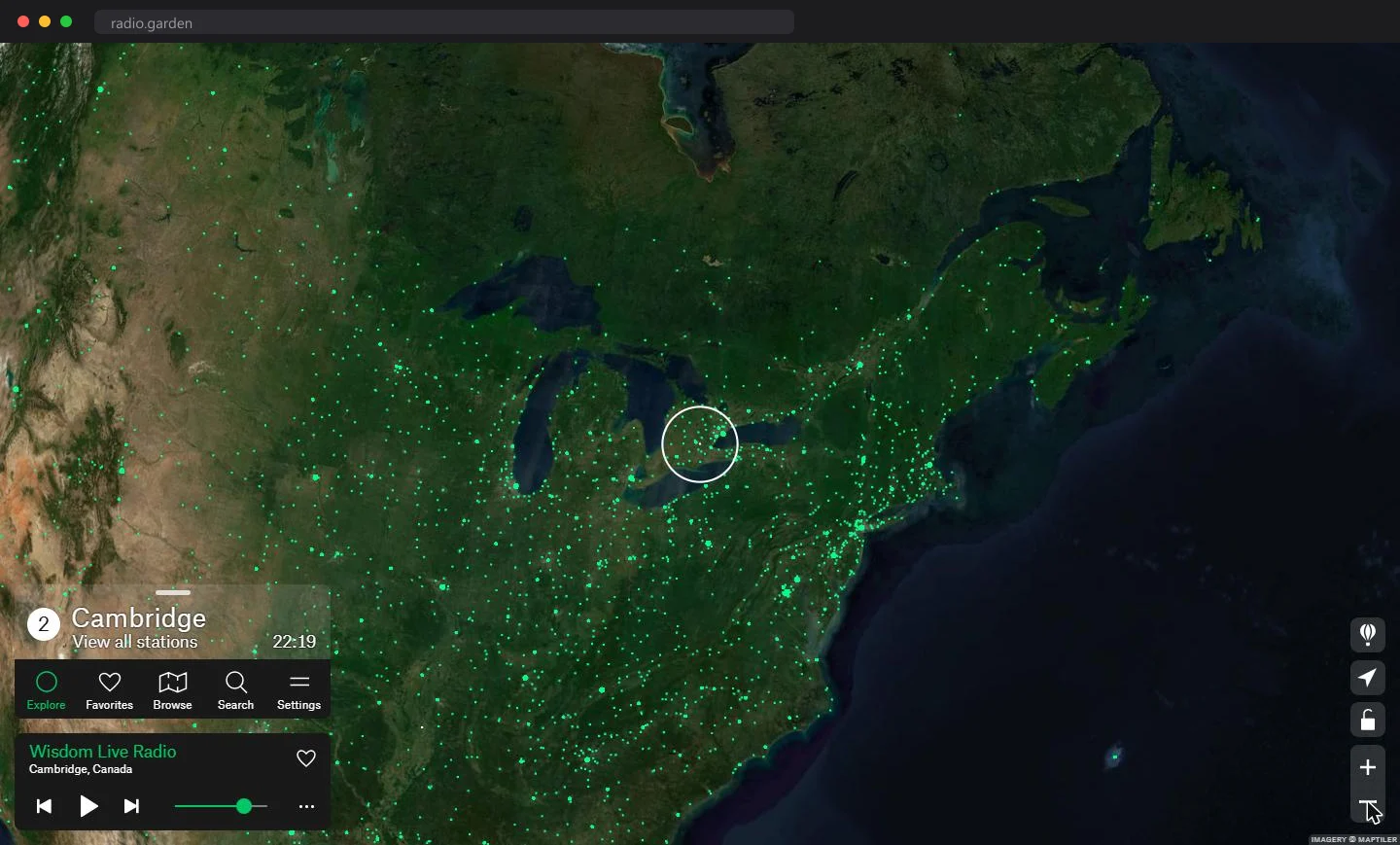
Radio Garden puts every live radio station on one rotating globe. The interface is a planet, the content is humanity, the click count is one.
Here is the entire user manual for one of the best interfaces ever shipped: spin the Earth, tap a green dot, hear that place, live, right now.
Radio Garden renders the planet as a globe stippled with dots, each one a radio station streaming at this moment. Drag to Reykjavik: someone is doing the weather. Drift to Lagos: someone is mid-sermon. Tap a dot in a town you cannot pronounce, and you are in its morning, its traffic, its ad for a furniture store. There is no search-first flow, no onboarding, no account. The globe is the interface, and the globe needs no tutorial because you have been practicing on it since kindergarten.
The numbers under the poetry: launched in December 2016 with close to eight thousand stations, the globe has since passed forty thousand, still filed as a non-profit foundation even after the rebuild got its own company around it. It began as a commission from the Netherlands Institute for Sound and Vision, an installation brief for a radio research project, and became the internet's favorite globe instead. There is a 2017 Webby in the trophy drawer.
The build under the dots
The makers, Studio Puckey and Moniker, gave a detailed technical interview the week it launched, and the original stack is a lesson in picking parts. The globe is Cesium, an open-source WebGL geospatial engine, skinned with satellite imagery rather than a drawn map, and that choice is the thesis: radio signals never respected borders, so the planet renders without any. On top, React with Redux managing state. Behind, the station database is served as JSON by Kirby, a file-based CMS, with Google's Time Zone API stamping local time onto thousands of towns.
Two engineering details deserve their own frames. Cesium wanted to redraw the globe sixty times a second even while nothing moved, poison for a site people leave singing in a background tab, so the team patched in a render loop that only draws when the camera moves. For a product whose core use case is playing for hours from a tab you forgot about, idling at zero draws is the difference between a radio and a space heater.
And finding the station nearest your view stopped being a brute-force loop over every city once they swapped in a k-d tree, the classic data structure for nearest-neighbor lookups. A k-d tree splits space along alternating axes so a query walks a short branch instead of checking every point, logarithmic instead of linear, which at tens of thousands of stations is the difference you can feel in your mouse hand.
The receipt is the ratio of interface to payoff. One gesture, one tap, and the payoff is functionally infinite: tens of thousands of stations, all live, a planet's worth of unedited humanity without a single recommendation algorithm in the path. Nobody decides what you hear next. Geography does.
What the garden grew into
The backstory is more academic than the toy lets on. The project gestated from 2013 to 2016 inside a radio research effort called Transnational Radio Encounters, with the Netherlands institute, a Martin Luther University of Halle-Wittenberg radio scholar named Golo Föllmer supervising, and five other European universities attached. The deliverable could have been a museum kiosk and a PDF. Puckey talked them into a public website instead.
The commission then outlived the museum by a decade and counting. By 2019 the site was drawing millions of monthly visitors, and Puckey turned Radio Garden into a company to keep it alive, rebuilding the next major version with CesiumJS still at its core. The station count in that writeup was 17,000, so the garden has better than doubled since, and better than quintupled from launch.
The rebuilt version shipped on March 14, 2020, which turned out to be days before half the planet got locked indoors with a sudden appetite for somewhere else. Native apps had arrived in 2018, and a search box only in 2019, three years after launch. That delay is its own design statement: the globe alone was interface enough for longer than most products survive at all.
There is a darker receipt for the no-borders thesis too. Turkey banned the site outright in 2022, and UK listeners are fenced to domestic stations by music licensing. The one line the satellite skin erased still bites back through the law, which rather proves why the designers wanted it gone.
I went looking for a current public listener count and came up empty; nothing newer than the 2019 writeup's millions a month seems to be on the record. The station counter is the receipt that keeps updating, and forty thousand live streams is not a number a dying project carries.
The design lesson deserves framing: when your data has a natural shape, use the shape. Radio stations live on Earth, so the browser gets an Earth. It sounds obvious and almost nobody does it, because a globe is harder to ship than a list. It is the same conviction that turned world population into columns you fly through.
The sibling that proves the rule is earth.nullschool.net, Cameron Beccario's live map of global wind, weather and ocean conditions, pulled straight from NOAA's servers and layered from the surface up to the 70 hectopascal band. It will show you air, ocean currents, atmospheric chemistry, particulates and space weather, each draped over the same drifting sphere, and you can scrub the date to replay a storm. Wind lives on a planet, so you get a planet. And when the data's natural shape is depth instead of geography, you get a page that runs straight down: the whole ocean, scrolled to the bottom.
If the globe itch catches, Cesium is open source and its tutorial hub walks you from a blank page to a spinning planet.
Somewhere on there right now, a station is playing exactly what you need. It is probably in Portugal. Go find it.
Next up
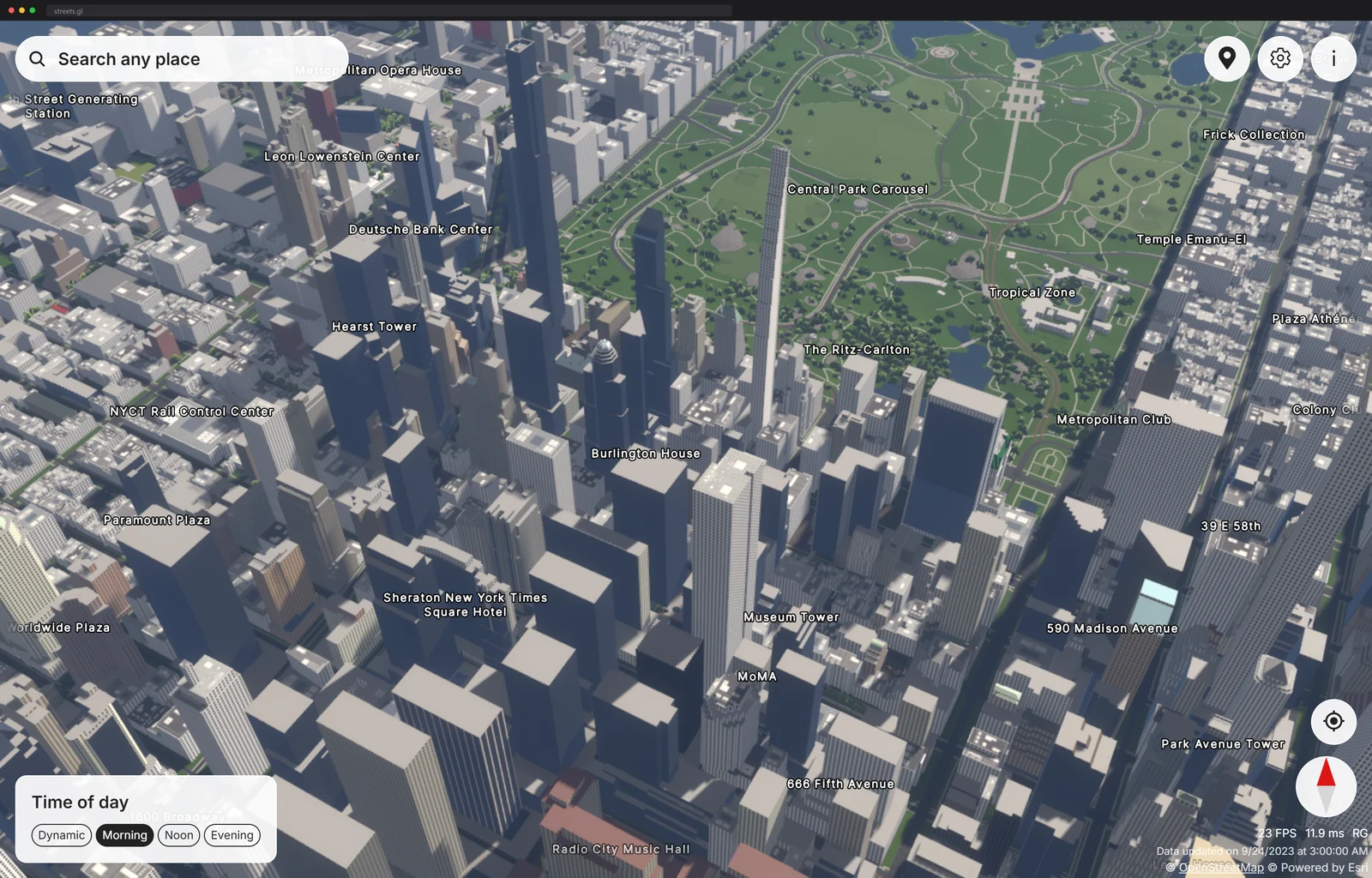
The flat map stands up: OpenStreetMap rendered as a 3D world