On the web
Floor 796 never ends, and one person is drawing it
An infinitely expanding isometric animation of a single building floor, added to for years, every pixel placed by hand. Zoom out and lose your afternoon.
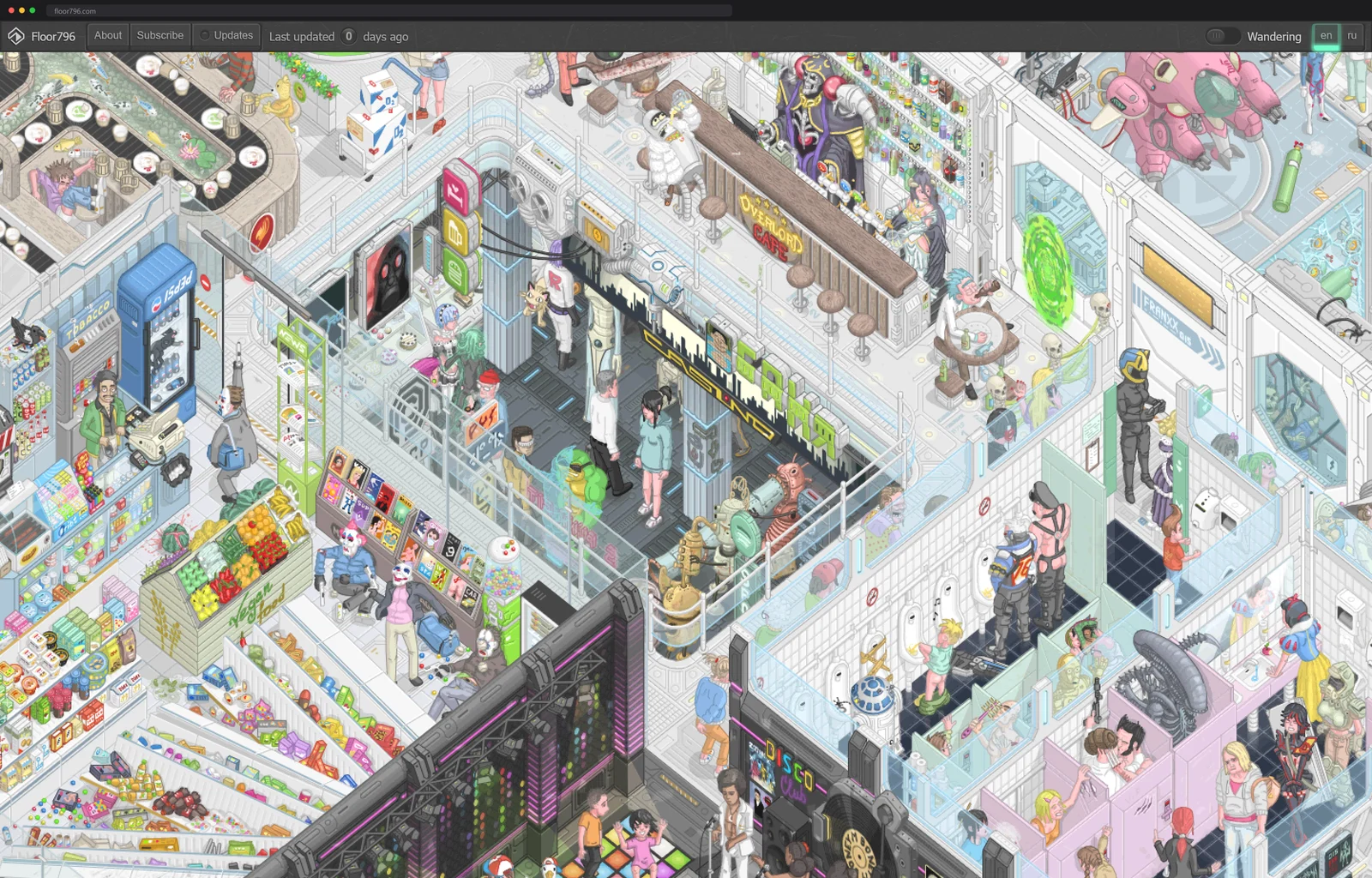
Somewhere on the 796th floor of an enormous space station, thousands of tiny animated people are living their absurd lives simultaneously, and one artist has been drawing them, scene by scene, for years.
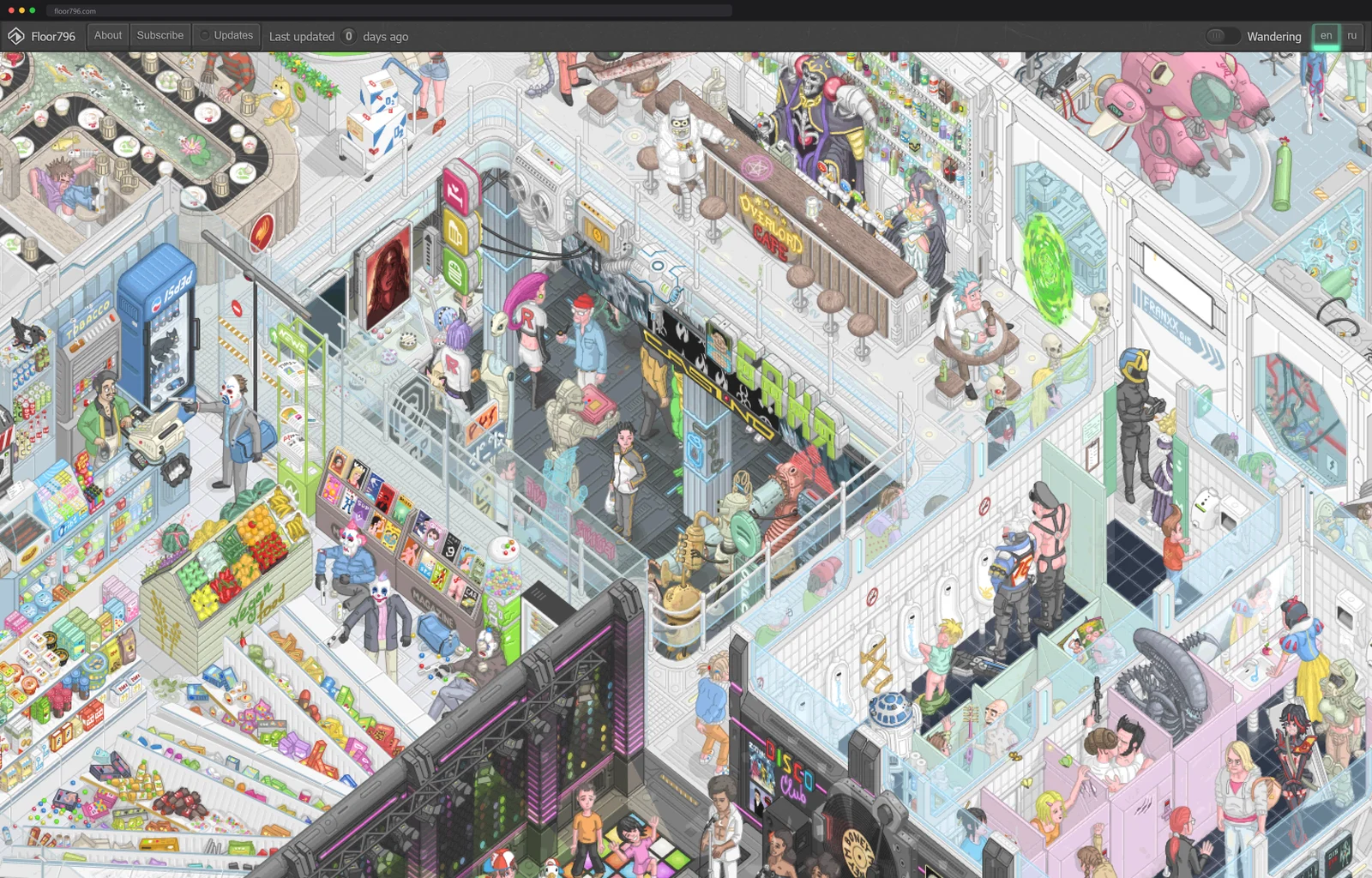
Floor 796 is an ever-expanding isometric animation. You pan across it like a map and zoom from the whole sprawling floor down to individual rooms where the jokes live: movie references, meme reenactments, tiny dramas in elevators. The floor grows as new scenes get drawn onto its edge, which means the artwork is never finished, only larger than it was last month.
The receipts, in both directions
The loop is 60 frames, five seconds at 12 frames per second, and by the time the maker wrote up his renderer in 2022 the scene had grown to 5,000 by 5,000 pixels of it, every frame hand-placed. The artist goes by 0x00: in an interview with 80 Level he describes himself as a Belarusian web developer, a CTO by day, who learned animation building Flash games in school, and who now budgets about two months of weekends per scene. Every scene is drawn in a Flash-style animation editor he built himself, in a fixed palette of exactly 4,356 colors. Others can submit scenes through that same in-browser editor, provided they match the house style; the site still credits all the animation to him.
The man behind the handle
For a long time the signature was just 0x00. Then Cartoon Brew got him on the record as Pavel Sannikau, a 36-year-old programmer who drew animated clips as a hobby starting in 2012, stopped for almost five years while software work ate his time, and came back because this one idea would not leave.
The numbers in that interview are the ones that rearranged my respect. Before drawing a single public scene he spent roughly a year building the editor. The project now carries more than 6,000 layers. When a pool scene needed water, he wrote a wave effect tool into the editor first, then drew the pool. New content lands every two to four days, and a full room averages about a month of work.
He plans nothing. His own description of the process is that while drawing one scene he thinks about the next, and whatever comes to mind gets drawn. Years of output, zero roadmap.
At the time of that interview the floor held 32 rooms. I tried to establish the current count for this update by panning the edge of the map and tallying, and I can report that the method fails somewhere past the fourth elevator bank, which is its own kind of receipt. The floor outgrew countability.
A video format invented for one artwork
Here is where it gets properly nerdy. His own engineering writeup (Russian, worth the machine translation) explains why ordinary video could not carry the piece: mp4 cannot keep multiple synchronized loops in lockstep, goes soft when you zoom into pixel art, and hiccups every time a loop restarts. So he invented his own format. Frames are color-quantized, encoded as deltas against a single keyframe, run-length compressed for an 83 percent cut, deduplicated across frames for another third, then gzipped. One gigabyte of PNG frames becomes an 82-megabyte stream.
In your browser, Web Workers decompress each visible chunk of the floor in 5 to 20 milliseconds against the 83-millisecond budget that 12 fps allows, and a plain 2D canvas draws the result. No WebGL anywhere. One worker per visible section, roughly half a gigabyte of memory at the ceiling, and years of hand labor scrolling on a phone without a loading bar worth mentioning.
The chunks those workers chew are 508 by 406 pixels each, the animation sliced into fragments that load and render on their own threads. That slicing is the whole reason an artwork this size pans like a static image.
The internet keeps rediscovering it
When the floor hit the Hacker News front page this January it collected 1,066 points and 119 comments, and the thread reads like people falling in one at a time. The site's FAQ facts did the rounds there: the project started in 2018, the entire first year went into the editor and render engine, the first block took over eight months, and a block now takes one to one and a half.
The comment that stuck with me was about the stack, or the absence of one. No framework, no build chain, no node_modules the size of a planet. Hand-rolled JavaScript and the custom format carry everything.
The thread also settled the name for me. 796 is not a floor number picked at random: the 7th, 9th and 6th letters of the alphabet are G, I and F. You have been looking at one enormous gif this whole time.
Sit with the ratio for a second. The loop plays for five seconds. Producing it has taken eight years so far, and the ledger only ever gets more lopsided, because every new block adds a month or more of labor to the same five seconds of runtime. It might be the worst playback-to-production ratio in animation. That is exactly the point of it.
This is the category of thing the internet was accidentally built for: one person's incomprehensible patience, distributed to everyone, free, with a zoom control. Museums would kill for it. It lives at a URL. It shares a shelf with the artist who draws full illustrations inside a single HTML div, in the small club of people who chose an absurd constraint and then honored it for years.
The lineage of absurd patience
The closest ancestor I know is the Zoomquilt, the collaborative infinitely zooming painting from 2004: fourteen illustrators, each painting a scene that dissolves into the next one's edges, still zooming twenty-two years later. Different axis, same refusal to ever call the thing done.
And if watching tiny workers mop a space station floor made your drawing hand twitch, Pedro Medeiros, the pixel artist behind Celeste and TowerFall, publishes his pixel art tutorials free, including a beginner series in compact 512 by 512 images. The distance between those exercises and floor 796 is only about eight years of weekends.
Budget warning: the search-for-references game is a trap with no bottom. Start at the elevator bank. You will know the one.
Next up
The AI runs the doors, and you have to talk to it